   |  |
| WORLD POLIO AWARENESS |
| Early in the 20th century polio (poliomyelitis) became the world's most feared disease. Children were most susceptible but adults were also infected. Polioyelitis is inflammation of the gray matter of the spinal cord. An acute viral disease characterized by fever, sore throat, headache, vomiting, and often stiffness of the neck and back. There may also be subsequent atrophy of groups of muscles ending in contraction and permanent deformity, or death. |
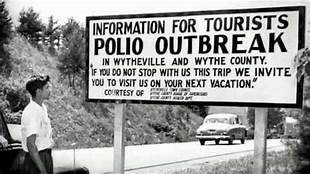 a country road in Virginia USA | circa 1950s |
| In the early 1900s, the east coast of the United States reported over 27,000 cases and 6,000 deaths just within New York City. Worldwide outbreaks of Polio were more severe during the summer months closing theatres, swimming pools, beaches and most public meeting and gathering places. A heroine in medical history, Sister Elizabeth Kenny was a Australian born nurse and health administrator who was also known as the Polio nurse. She dedicated her life to those suffering from polio and developed a science-based method of physical therapy to help with the pain and suffering while mobilizing limbs, chest, neck and back to keep the good muscles in shape. Sister Kenny traveled around the world teaching her proven methods to numerous health institutions and universities. Her United States visit included a meeting with President Franklin D Roosevelt, who had polio and confined to a wheel chair. Rumor has it they had a splendid visit. Sister Kenney was a world leader in the eradication of polio but emphasized her compassion for life while relieving pain and suffering. While in North America, Sister Kenny established the Sister Kenny Rehabilitating Institute in the state of Minnesota. |
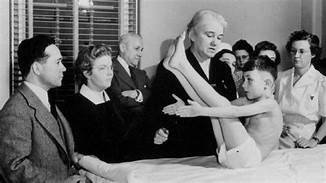 Sister Elizabeth Kenny with polio patient, Australia | circa 1940s |
| Elizabeth Kenney — born on the 20th of September, 1880 - Warialda, New South Whales, Australia and died the 30th of November, 1952 - Toowoomba, Queens, Australia. |
| Pictured on the right is an image of an iron lung which was invented by Drinker, Shaw, and Wilson at Harvard Medical School and was first used on October 12, 1928 at Boston's Children's Hospital. The iron lung assisted patients with breathing when they were unable to do so on their own. Due to the paralyses nature of polio, especially on the lungs, the iron lung was widely used to provide a mechanical form of breathing. As you can imagine, these machines look frightening and they produced a lot of mechanical noise. Many iron lungs were placed within walls of hospitals to alleviate the noise and images of the mechanic lung from family visiting loved ones | 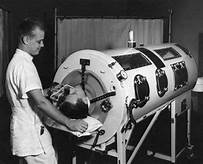 nursing attendant with patient in an Iron Lung circa | 1950s |
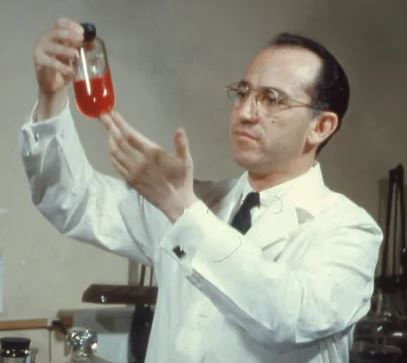 JONAS SALK physician and scientist credited with discovering the Polio vaccine | Two vaccines were used throughout the world to combat polio. The first was "poliovirus vaccine, inactivated" or IPV developed by Jonas Salk after having isolated three strands of the poliovirus. After clinical trials his vaccine was introduced on April 12, 1955. The Salk vaccine, or IPV, was an injection of the inactive (dead) poliovirus. |
| Immediately following licensing, vaccination campaigns were launched then by 1957, following mass immunizations sponsored by the March of Dimes, the annual number of polio cases in the United States was reduced from 58,000 to 5,600 cases. Further research, lead by Albert Sabin, studied the cadavers of those who died from the poliovirus. He developed "poliovirus vaccine, live oral" or OPV. This new active and oral vaccine was concealed within a sugar cube and was swallowed then absorbed through the digestive process. A US approved clinical trial in April of 1960 in the city of Cincinnati proved to eradicate the Polio virus completely. Sabin's new and improved vaccine became the worldwide standard immunization against Polio. |
| Albert Sabin — Born in Poland the 26th of August, 1906, and died the 3rd of March, 1993, in Washington DC as an American Citizen. |
| Jonas Salk — Born in NYC the 28th of October, 1914, and died the 23rd of June, 1995, in La Jolla, California. |
| The efforts of the World Health Organization, the United Nations, and many global health institutions are our only hope in preventing the reemergence of deadly diseases. Their efforts in countries with limited resources including, food, water, sanitation. |
| LICE (PEDICULOSIS) | |||
| LOUSE Pediculus |
BODY LOUSE Pediculus humanus corporis |
||
| HEAD LOUSE Pediculus humanus capitis |
PUBIC LOUSE (crab) Phthirus inguinalis pubis | ||
Head and body lice are transmitted through direct body-to-body contact and by sharing clothing (including hats), towels, bedsheets/linens, and through direct body contact. Under a microscope, pubic lice resemble tiny crabs (which is where the nickname "crabs" comes from). As its name implies, pubic lice are most often found in the pubic area. If a person is very hairy, pubic lice can also appear in other places on the body. Similar to body lice, pubic lice are transmitted by sharing clothing (including hats), towels, bedsheets/linens, in addition to undergarments, and sexually through direct body-to-body contact. What to do:
| |||
| THE RABIES DISEASE | |
 Louis Pasteur, scientist founded Pasteur Institute b. December 22, 1822 Bourgogne-Franche-Comté, Dole, France d. September 28, 1895 Marnes-la-Coquette, France |
French scientist, Louis Pasteur, together with fellow Frenchmen, Emile Roux, began working on a Rabies vaccine. Their theory was, that if a person or an animal was exposed to a weakened form of the disease, the body would develop its own defense mechanisms against it. Pasteur's first human patient was a young boy who was mauled by a rabid dog and subsequently became ill with the disease. Joseph Meister was the boy's name. He was given 13 injections of the still experimental rabies serum, the most grateful boy grew up to become the caretaker of the Pasteur Institute. |
During the invasion of France by Nazi Germany, Joseph, then in his mid 60's, sent his family to safety and stayed behind to safeguard the institute. Thinking that he made a mistake and was sure that his family was dead, he committed suicide by natural gas; his family survived. | |
Information on this Web site provides visitors with information for knowledge, awareness, and correspondence. Do not use the resources on this Web site as a substitute for professional medical care and we urge you to work with your medical care providers for answers to your personal health questions. This Web site is copyright protected and content represents information deemed reliable and accurate at the time of posting; content aligned with goals of the organization. All branding images used as url links are the property of the organizations to which they point. Linking of third-party information may need prior approval of the author. |